
In what cases and for what the engine diagnostics is carried out?
An ordinary motorist needs engine diagnostics in two cases.
The first – when buying a used car, the natural question arises, in what condition is his “heart” – the engine and will it last long?
The second – in the event of any problems with the engine, the appearance of incomprehensible noises or knocks, increased oil consumption, reduced power, “triple”, etc.
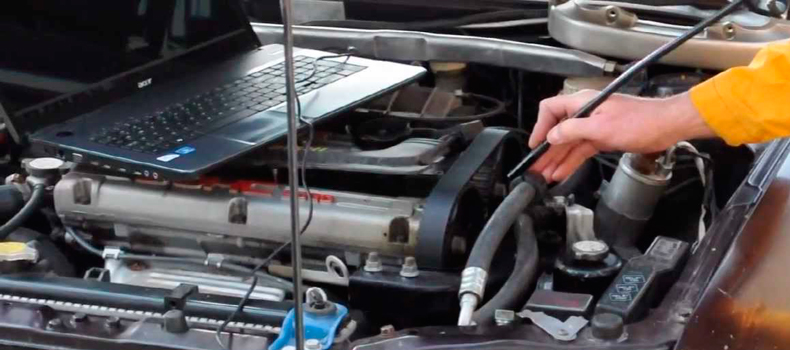
I will describe diagnostic methods that are available to almost everyone and do not require any special equipment. As well as the most common engine problems.
The first method is called “visual”, it really does not require any devices, except for the “candle” key and the key 10 to remove the cover of the air filter housing. This method is more suitable for rapid diagnostics when buying a car, and is also the initial stage in conducting more detailed diagnostics using some equipment, let’s call it “instrumental” engine diagnostics.
Engine diagnostics visually
First we listen to the sounds of the engine.
It is better to see once than to hear a hundred times, and it is better to hear once than to describe a sound a hundred times … But I will try. In the beginning, make sure that the sound that alarmed you comes from the engine and not from other parts and parts of the car. Suspension parts, exhaust system parts, engine mounting parts, attachment parts, crankcase protection parts, etc. can vibrate and knock against each other. Here are some tips. By depressing the clutch pedal, you almost completely eliminate the sounds made by the gearbox and transmission (clutch). By rocking the engine (the engine is attached to the body or frame on elastic cushions and has some mobility) you can detect sounds coming from the engine suspension, crankcase protection, exhaust system, etc. By removing the generator belt, you can eliminate the sounds made by the generator and the pump – a water pump (“classic”). So before you “sin” on the engine, listen carefully to its “environment”.
Divide the sounds into four categories.
-
- – Loud knocking sounds coming from the top of the engine usually come from the valve mechanism. Most likely, this is a signal that you need to adjust the valves, if it is not done in time, or increased wear of the valve mechanism, or failure of one of the elements of this mechanism. A few additions. Wear of the camshaft and adjusting washers of the 08th motor is very slow compared to the camshaft and rocker arms of the “classic” engine. This is due to design features – the 08th camshaft rubs against the adjusting washers in the oil bath, and in the classic lubrication is carried out differently, less efficiently. And about the 08th engine – the sound is emitted by increasing the thermal gap, almost no different from the sound emitted by a worn “cup” on which lies the adjusting washer.
- – Rustling metal sounds that change their character when changing the engine speed coming from the front of it. Most likely, this sound is made by a poorly tensioned chain, and possibly fragments, already torn off the weakened chain, the calming chain. Well, once the chain is mentioned, then naturally it refers to the “classics”. On the 08’s, from the timing belt (gas distribution mechanism), also lacks a variety of sounds – touching the protective cover of moving engine parts, tapping a loose belt on the casing when changing engine speed, the rustle of the tensioner roller and various sounds made by the pump.
- – Mid-range and low-pitched sounds with a frequency significantly lower than the valve sounds that come from the middle and bottom of the engine and change or appear with increasing speed. These sounds are more “unpleasant”, as they can indicate serious problems with the engine – increased wear of the cylinder-piston group, wear of the crankshaft necks and liners. In general, these sounds can be a harbinger of engine overhaul.
- – There is another specific sound in the “classic”, reminiscent of grunting, so sounds the roller drive auxiliary units (oil pump and shock absorber). For the sound and appearance (thick and short) this roller is popularly nicknamed “piglets”.
The metallic loud knock which appears at acceleration of the car or on the car standing at sharp increase in turns of the engine. These are detonation knocks. Detonation – an explosion of a combustible mixture in the combustion chamber, not a smooth (relative to the explosion) of its combustion from the ignition of the spark plug. Detonation occurs for various reasons, the main – it’s too early ignition, poor quality gasoline, depleted fuel mixture, reducing the volume of the combustion chamber due to the formation of a large amount of soot, engine overheating. People call this phenomenon – “fingers are knocking”. In fact, the main sound we hear is made by the engine pistons, which take the shock wave from the explosions of the fuel mixture in the combustion chambers. Detonation is a very harmful phenomenon, prolonged driving with such sounds leads to the destruction of the engine, especially the piston rings, the partitions between the grooves on the broken, etc.

Next we look at the exhaust gases.
- if the smoke is black with a hint of gasoline, it indicates an excessive mixture, the malfunction of the carburetor, and says nothing about the condition of the engine.
- if the smoke is bluish in color with the smell of burning, it indicates that the oil enters the combustion chamber and burns there. This smoking clearly indicates an overuse of oil. Oil consumption up to 200-300 g. at 1000 km. mileage by smoking is not always clearly defined. If the consumption is more than 300 gr., It is almost always noticeable on the exhaust.
The nature of smoking can determine the culprit of oil consumption.
- If the smoke clearly increases with a sharp increase in engine speed, and when working at idle or high, but constant, it is almost non-existent, it indicates a problem with the oil-reflecting valve caps.
- In the worst case, there may be increased wear or breakage of the engine valve bushings.
To check the assumption that the oil enters the combustion chamber through the caps and bushings, turn the spark plugs and carefully examine them.
- The presence of oil on the threaded part of the spark plugs confirms leakage through the caps – bushings.
- Wear of bushings, to such an extent, can occur only on old motors with high mileage.
- But the wear of the caps or the loss of their elasticity is very common. For example, the use of poor quality oil, getting into the oil of gasoline or engine overheating, it happens on completely “fresh” engines. But this problem is solved quickly and easily by replacing m / o caps.
Things are much worse when the smoke falls constantly, not just when gassed.
These are already problems of the cylinder-piston group of the engine.
Increased wear of rings and pistons is possible – for old engines or “occurrence” of rings in piston grooves or their breakage that happens and on “fresh” motors. In case of “occurrence” (coking) of rings, it is possible to manage “therapeutic treatment”, in other cases it is necessary to disassemble the engine. Laying of rings can be preceded by an overheat of the engine, use of low-quality oil, long parking of the car. The oil ring at the end of the muffler serves as additional confirmation of the problems with the CNG (cylinder-piston group) ..
Do not confuse the exit of the muffler with water smoke. On an unheated engine, with a still cold muffler due to condensation of moisture, a large amount of steam and water droplets, especially in cold or wet weather. Therefore diagnostics of the engine on an exhaust becomes only on the well warmed up engine.
Remove the air filter housing cover.
If the air filter “floats” in oil, and from an aperture of system of ventilation of crankcase gases pulsating clubs of vapors of oil and gas break out, then it is time for this engine for capital repairs.
And the last in this section. If at consciously serviceable ignition system, the serviceable carburettor and absence of air suction the engine “triples” (noticeably shakes at idle speed, has failure, an uneven exhaust), then we start instrumental diagnostics.
Engine diagnostics is instrumental
Tool diagnostics of the engine gives us a more complete picture of the condition of the engine and allows you to more accurately identify the problem, which in turn will save time and money on repairs. For such diagnostics of the engine some tool – the compressometer and the device for air supply to engine cylinders (2-3 atm is enough) and definition of a compression stroke in the cylinder is necessary. Compressors are sold in almost all parts stores, and you can rent from friends. If there is no compressor, then the wheel of our own car will be suitable for our purposes. In the presence of a hose of the necessary length and diameter and skillful hands it is possible to adapt and provide short-term air supply to the engine cylinder when carrying out procedures about which I will tell further.
The device for determining the compression stroke can be just a piece of cloth, slightly impregnated with oil and inserted into the hole of the candle. When scrolling the crankshaft, with the valves closed and the piston moving up (this is the compression stroke), our rag will pop out of the spark plug hole. This is the moment we need to capture. Just do not spare the rags, a very small piece can be sucked into the cylinder, then bother to pull it out. It is very convenient to use for this procedure a whistle docked with a candle hole. We inserted the whistle and turn the crankshaft of the engine, heard the whistle – this is the position of the piston we need.
About the devices, it seems all told. Now, why all this is needed. If the engine “triples”, then without instrumental control can not do. So let’s get started.
- Compression measurement is done to identify the “sick” cylinder. It is very convenient to do it by means of the closing button giving “plus” from the accumulator on the retracting relay of a starter. At the same time the regular wire going from the ignition lock on a starter is disconnected. If there is no suitable button, 2 meters of wire, connector and “crocodile”, then you have to turn the engine starter from the ignition, there is no helper. And do not forget to remove the central high-voltage wire from the shock absorber, providing a spark gap of 3-5 mm. between the metal tip and the mass. And yet, during the procedure, the assistant behind the wheel of the car should keep the accelerator and clutch pedals depressed – easier to suck air into the engine cylinders through the open throttle valves of the carburetor and easier starter to turn the engine with the gearbox disconnected.
So, measurements are made. That cylinder in which compression noticeably differs from others, and is “sick”. If the difference is less than the 1st atmosphere, then go back in search of the reasons for the “tripling” back to the ignition, carburetor, air intake and more. The scatter in the 1st atm., Most likely, will indicate some uneven wear of LPG, which is quite acceptable for engines with a mileage of more than 50-70 thousand km. The amount of compression should be approximately equal to the degree of compression multiplied by 1.3. You can find the amount of compression of the engine in the technical characteristics of your car. Why approximately? Because this value depends on many variables – engine temperature, oil viscosity, battery charge, etc. And the scatter in the accuracy of the readings of different compressors reaches 2 – 3 atm. So our main guideline is to compare the compression values between the cylinders. The compression in the “sick” cylinder does not have to be less than in others. For example, excess oil entering the engine cylinder increases the compression, which can be confirmed by a spark plug turned out of it and has growths from the combustion of this oil. And the reasons of hit of superfluous oil in the cylinder can be also the broken oil-removal piston ring, defect in pair the valve – the directing plug, etc.
- Consider the case of falling compression in one of the engine cylinders. This defect is the most common. First of all, pour into this cylinder 10 – 15 ml. pure oil and again measure the compression in it. If the pressure has increased significantly and even exceeded the readings in other cylinders, it indicates a breakage or occurrence of the piston rings. If the readings have not changed, the cause of the compression drop in this cylinder may be a loose fit of the valves to the seats (burnout or incomplete closing due to improper clearance adjustment), damage to the cylinder head gasket, piston burnout or crack in it. To more specifically determine the cause of the compression drop, set the piston of this cylinder to a position close to TDC (top dead center) on the compression stroke and supply compressed air to the cylinder at a pressure of 2-3 atm. (How to do it is described above). At the same time do not forget to include the 4th or 5th transfer and to fix the car from movement by a “towel” or blocks. Damage to the cylinder head gasket can be determined by the hiss of air from an adjacent spark plug hole. The air outlet through the carburetor will indicate that the intake valve is not tight. Increased air output from the oil filler neck (with the plug removed) indicates a burn or crack in the engine piston. The air outlet through the muffler of the car indicates a problem with the exhaust valve. Most often, the exhaust valve burns out – this “trouble” occurs in the “triple” of the motor in 90% of cases.